


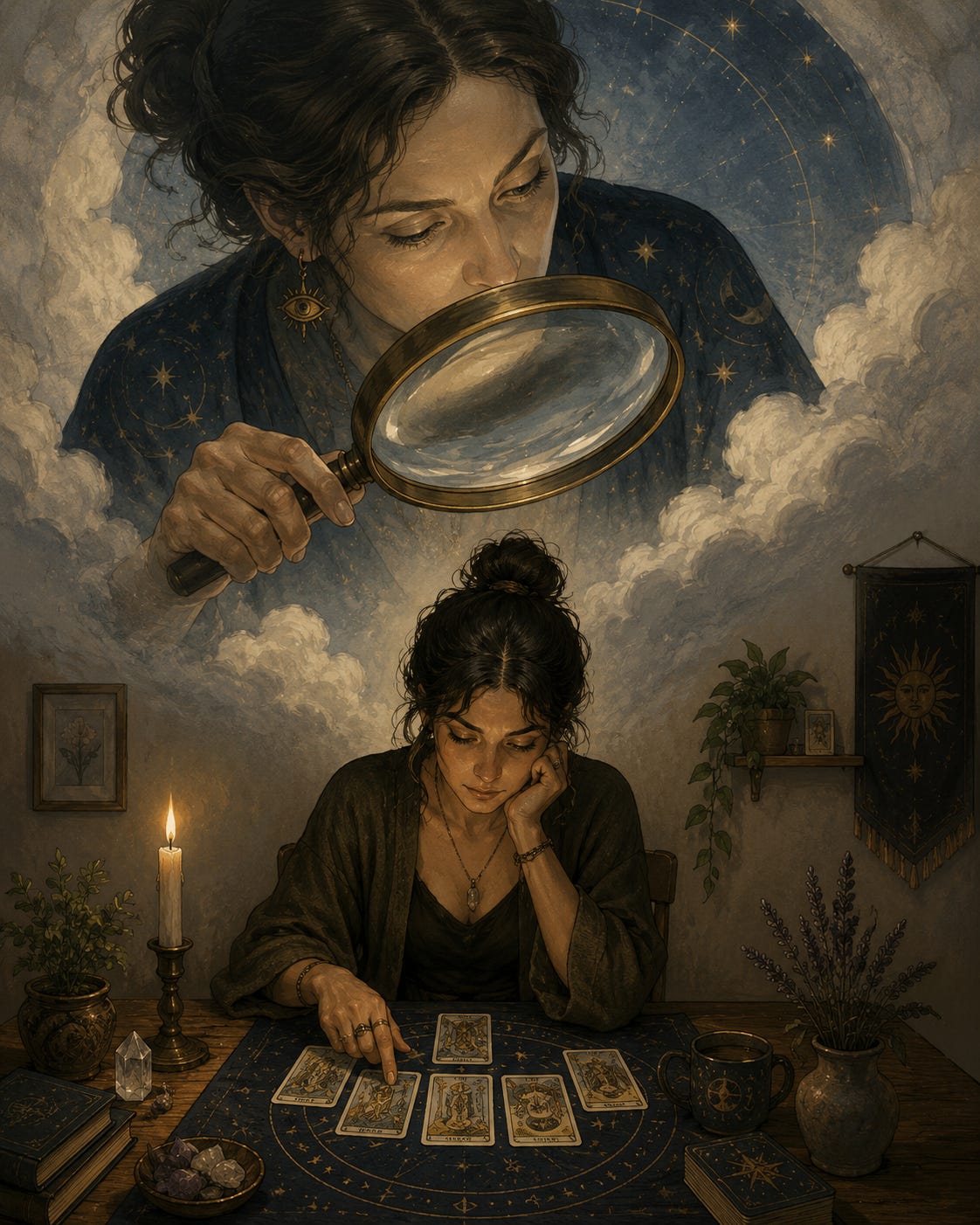
Sometimes I look around at all my tarot decks, at my tarot books and I am fascinated by my own fascination with it. I don’t have many passions or likes, that is just the way I am, very linear in my likes and dislikes, and I am very consistent, but, somehow, the Tarot by passed this and I love it, even all these years later.
I think, for me, it is a good blend of magic, knowledge, story telling and playfulness that is just a perfect match for my own mind.
This got me thinking. What kind of people are drawn to Tarot? Do they have a certain psychological make up? Is there a type of ‘tarot person’? So a bit of research was required. Below my conclusions based on what I could find online.
Openness to Experience
It seems that the personality trait most strongly associated with an interest in tarot is Openness to Experience, one of the Big Five personality dimensions*.
People high in openness tend to enjoy symbolism, imagination, art, philosophy, mythology, and exploring unconventional ideas. They are comfortable with abstract thinking and are naturally drawn to systems that communicate through metaphor rather than straightforward facts.
Tarot as a Tool for Reflection
Many people do not use tarot to predict the future. Instead, they use it as a structured form of self-reflection.
A tarot spread often leads to questions like:
Why am I reacting this way?
What am I not seeing?
What can I learn from this?
This way the cards function as an introspective tool, supporting us to look inside and learn about ourselves.
During Times of Change
It seems that the interest in tarot, and other worldly practices, often increases during periods of uncertainty or transition.
Career changes, relationship difficulties, grief, illness, moving home, or retirement all create situations where people naturally search for meaning and need support to navigate the uncertainty of it all. The Tarot helps to organize thoughts and emotions when life feels unpredictable.
Comfort with Uncertainty
Tarot also appeals to people who tolerate ambiguity well.
Rather than insisting that every question has a single correct answer, they are comfortable considering multiple possibilities. They see uncertainty as something to explore rather than fear or ignore.
Story Tellers
Many tarot enthusiasts are natural narrative thinkers.
Rather than seeing life solely as a sequence of causes and effects, many tarot enthusiasts naturally think in stories. They instinctively look for themes, metaphors and connections between experiences. Archetypal images such as The Fool, The Hermit, The Star and The World resonate because they represent familiar stages of human experience rather than simply depicting isolated events.
Spiritual, Religious or Neither
Tarot users come from remarkably diverse belief systems.
Some view the cards as a spiritual practice. Others approach them from a psychological perspective inspired by Carl Jung. Some are atheists who simply enjoy the symbolism, while others are artists, writers, historians, or collectors fascinated by the imagery and history of tarot.
A Love of Symbols
One thing many tarot enthusiasts have in common is a fascination with symbols. A single image can carry multiple meanings at once, depending on the reader, the context and even the question being asked. For people who enjoy literature, mythology, psychology or art, this symbolic richness can be deeply satisfying.
Intelligence Has Little to Do with It
There is no evidence that tarot users are less intelligent or less educated than the general population.
The more meaningful distinction is not who uses tarot, but how they use it. Some users believe the cards predict the future, while others use them to access their own thoughts, emotions, and intuitions.
A Healthy Relationship with Tarot
For most people, tarot is simply a reflective practice or a creative exercise.
Like any belief system or personal practice, however, it can become unhealthy if it replaces independent decision-making or creates excessive dependence. Used in moderation, many people find it encourages thoughtful reflection rather than passive prediction.
Carl Jung and Symbolic Thinking
Although Carl Jung never promoted tarot as a method of fortune-telling, many psychologists and tarot enthusiasts have noticed parallels between tarot imagery and Jung’s concept of archetypes.
From this perspective, the cards do not predict the future. Instead, they activate symbolic thinking, encourage unconscious associations, and help people explore aspects of themselves that may otherwise remain unnoticed.
Four Common Ways People Use Tarot
Most tarot users fall into one, or a combination, of four broad groups:
Believers - who see the cards as providing genuine guidance or insight.
Psychological users - who use tarot as a framework for self-reflection.
Creative users - who use the cards to inspire writing, art, or problem-solving.
Collectors and historians - who appreciate the artistic, historical, and cultural dimensions of tarot.
I think I have a bit of each one to be fair. Some days more of one than the other. So interesting to research this topic, quite educational for myself.
What draws you to tarot and how do you use it?
*The Big Five personality dimensions: Openness to Experience, Conscientiousness, Extraversion, Agreeableness, Neuroticism (sometimes called Emotional Stability, reversed).
A mix of self-reflection and storytelling.
Also I enjoy the historical elements of tarot.
When I was a preteen I enjoyed card games.
Symbols, too, are a portal.